
Online Education
Can Non-Tech Students Build A Career In Ai? A Realistic Guide For BBA, B.COM, BA and MBA
Published: Fri Jun 26 2026Updated: Wed Sep 09 20265 min read129 Reads

A. INTRODUCTION
Artificial Intelligence is no longer limited to engineers, coders, or data scientists. Today, AI is influencing how businesses market products, analyse customers, improve operations, manage finances, and make decisions. That is why many students from BBA, B.Com, BA, and MBA backgrounds are now asking an important question:
Can non-tech students build a career in AI?
The short answer is yes—but not every AI role is the same, and non-tech students need a realistic roadmap rather than hype. While highly technical roles like Machine Learning Engineer or AI Researcher usually require coding, statistics, and computer science knowledge, there are many AI-related roles where business understanding, analytics, communication, research, and problem-solving matter just as much.
If you are from a non-technical background, the goal is not to copy an engineering student’s path. The smarter approach is to identify where your degree, strengths, and interests fit into the AI ecosystem and then build the right skills around it.
In this guide, we’ll look at:
- whether non-tech students can realistically enter AI,
- the best AI-related career paths for BBA, B.Com, BA, and MBA students,
- the skills you should build,
- and a step-by-step roadmap to get started.
B. CAN NON-TECH STUDENTS BUILD A CAREER IN AI? THE SHORT ANSWER:
Yes, non-tech students can absolutely build a career in AI—but usually through AI-related, AI-enabled, or AI-adjacent roles, rather than directly jumping into deeply technical jobs.
When students hear “career in AI,” they often imagine only roles like:
- AI Engineer
- Machine Learning Engineer
- Data Scientist
- NLP Engineer
These are important roles, but they are only one part of the AI job market. As AI becomes part of business, marketing, finance, operations, customer service, and product development, companies also need professionals who can:
- analyse data and business performance,
- use AI tools to improve workflows,
- understand customer behaviour,
- support AI projects,
- translate business needs into solutions,
- and help teams use AI effectively.
- That’s where non-tech students can find strong career opportunities.
C. WHY AI IS NOT ONLY FOR ENGINEERING STUDENTS
One of the biggest myths around AI is that only coding-heavy profiles can enter the field. In reality, AI creates opportunities at three levels:
1.Technical AI roles
These include Machine Learning Engineer, AI Engineer, and Data Scientist roles. They usually require coding, mathematics, statistics, and a strong technical foundation.
2. Hybrid roles
These roles sit between business and technology. Examples include:
- Business Analyst
- Data Analyst
- Product Analyst
- Reporting Analyst
- Business Intelligence Executive
- AI Project Coordinator
These are often more realistic entry points for non-tech students because they combine analytics, business understanding, and tool-based work.
3. Business and strategy roles in AI
As AI becomes part of business operations, companies also need professionals in:
- AI consulting
- product management
- operations
- AI-enabled marketing
- digital transformation
- customer insights
This is where many BBA, B.Com, BA, and MBA students can create value—especially if they learn analytics, AI tools, and business problem-solving.
So yes, AI may be a technology field, but AI careers are no longer limited to programmers.
D. BEST AI CAREER PATHS FOR BBA, BCOM, BA, AND MBA STUDENTS
A.For BBA Students
BBA students already understand business basics, operations, marketing, and management. This makes them a good fit for AI-related roles that combine business thinking with analytics.
Suitable career paths:
- Business Analyst
- Product Analyst
- Operations Analyst
- Marketing Analytics Executive
- AI Project Coordinator
- Customer Insights Analyst
What to focus on:
- Excel and reporting
- business analytics
- dashboards and data interpretation
- AI use cases in marketing, operations, and customer analysis
B.For B.Com Students
B.Com students often have a strong comfort level with numbers, reporting, and finance. This can translate well into AI-enabled roles in analytics, finance operations, and business intelligence.
Suitable career paths:
- Financial Data Analyst
- Reporting Analyst / MIS Analyst
- Business Intelligence Executive
- Finance Analytics Associate
- FinTech Operations Analyst
What to focus on:
- Excel
- SQL basics
- Power BI or Tableau
- financial reporting and KPI analysis
- AI tools used in finance and reporting
C.For BA Students
BA students may not follow a traditional analytics route, but they can still build strong careers in AI-related fields—especially in research, communication, digital strategy, and AI-assisted workflows.
Suitable career paths:
- Research Analyst
- AI-enabled Content or Communication Roles
- Digital Marketing and Audience Research
- Prompt Operations / AI Workflow Support
- Customer Insights or User Research Support
What to focus on:
- research and communication
- AI tools for content and workflow support
- digital marketing basics
- prompt writing
- basic analytics and audience understanding
D.For MBA Students
MBA students are well-positioned for AI careers that involve business strategy, analytics, product thinking, and leadership.
Suitable career paths:
AI Product Manager
AI Consultant
Business Intelligence / Analytics Manager
Marketing Analytics Manager
Program / Project Management in AI initiatives
What to focus on:
- analytics and dashboard interpretation
- AI use cases in business
- product and project thinking
- cross-functional communication
| Degree | Best AI-Related Roles | Skill to Build |
|---|---|---|
| BBA | Business Analyst, Product Analyst, Operations Analyst, Marketing Analytics Executive | Excel, dashboards, business analytics, customer insights |
| B.Com | Financial Data Analyst, MIS Analyst, BI Executive, Finance Analytics Associate | Excel, SQL, Power BI, KPI reporting |
| BA | Research Analyst, AI Content/Prompt Operations, Digital Marketing, Audience Research | communication, AI tools, research, content strategy |
| MBA | AI Consultant, Product Manager, Analytics Manager, Transformation Analyst | strategy, analytics, AI use cases, stakeholder communication |
E. STEP-BY-STEP ROADMAP TO ENTER AI WITHOUT A TECH BACKGROUND
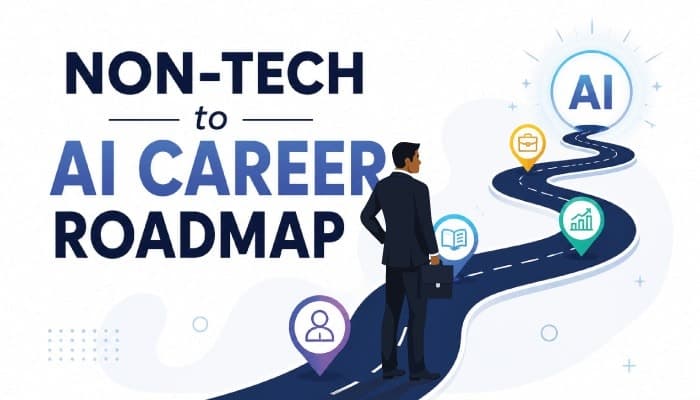
If you are serious about building a non-tech-to-AI career path, follow this practical roadmap.
Step 1: Choose the right path within AI
Do not start with “I want a career in AI” as a vague goal. Start by asking:
- Do I enjoy numbers and analysis?
- Am I more interested in business strategy, marketing, or operations?
- Do I enjoy research, communication, or content?
- Do I enjoy research, communication, or content?
- Am I willing to learn technical tools, or do I want a low-code route first?
This will help you decide whether your best path is:
- analytics
- business intelligence
- AI-enabled marketing
- operations
- research
- product or consulting
Step 2: Build AI awareness first
Before choosing a course, understand the basics:
- What is AI?
- What is Machine Learning?
- What is Generative AI?
- What kind of jobs are being created around AI adoption?
You do not need deep technical knowledge at this stage. You need clarity on where AI fits into business and careers
Step 3: Build one strong practical skill
A common mistake is trying to learn everything at once. Instead, start with one practical skill that improves your employability
Good starting options:
- SQL
- Prompt writing and AI productivity tools
- Business Analytics basics
If you want research / communication / marketing roles:
- AI tools for research and content
- audience analysis
- digital marketing basics
- structured communication
Step 5: Work on 2–3 mini projects
Projects matter because they show that you can apply what you learned.
Good project ideas:
- a sales or marketing dashboard
- a financial reporting dashboard
- customer behaviour analysis
- an AI workflow for automating repetitive business tasks
- audience research using AI tools
Even small projects can strengthen your resume, LinkedIn profile, and interview confidence.
Step 6: Target AI-adjacent roles first
You do not need to start with “AI Engineer.” A much smarter approach is to enter the ecosystem through roles like:
- Business Analyst
- Data Analyst
- Product Analyst
- Business Intelligence Executive
- AI Project Coordinator
These roles help you build practical experience, understand how businesses use AI, and grow into more advanced roles later.

F. SKILLS NON-TECH STUDENTS SHOULD BUILD FOR AN AI-RELATED CAREER
No matter which degree you have, these are some of the most useful skills to build:
1. AI Fundamentals
Understand what AI is, where it is used, and how businesses are adopting it.
2. Excel / Spreadsheet Analysis
Still one of the most practical skills for reporting, business analysis, and entry-level data work.
3. SQL
Very useful for analytics, reporting, and business intelligence roles.
Prompt Writing and AI Tool Usage
Especially useful for research, content, marketing, and productivity-focused roles.
Communication and Business Thinking
Important for consulting, strategy, product, operations, and management roles.
. Basic Data Interpretation
You don’t need advanced mathematics, but you should be comfortable reading trends, metrics, and business reports.
| Skill Area | Why Matters | Best For |
|---|---|---|
| AI Basic | Helps Understand the field and job opportunities | eveeryone |
| Excal/spreadsheets SQL | Entry-level analysis ans reporting Helps work with data | BBA,B.Com,MBA |
| Power BI / Tableau | Visualizing and presenting data | Visualizing and presenting data Analytics-focused students |
| Prompt writing | Useful for AI tools and productivity | BA, BBA, MBA |
| Prompt writing | Useful for AI tools and productivity | BA, BBA, MBA |
| Business problem-solving | Important for consulting, product, and operations roles | BBA, MBA |
| Communication & research | Needed in AI content, research, and strategy roles | BA, BBA, MBA |
G. BEST AI-RELATED JOBS FOR NON-TECH STUDENTS
Here are some realistic roles non-tech students can target:
- Business Analyst
- Data Analyst
- Product Analyst
- Business Intelligence Executive
- Reporting / MIS Analyst
- Operations Analyst
- Marketing Analyst using AI tools
Some advanced long-term options—after gaining skills and experience—can include:
- AI Consultant
- AI Product Manager
- Transformation Analyst
- Analytics Manager
MISTAKES NON-TECH STUDENTS SHOULD AVOID
1. Thinking AI means only coding-heavy jobs
AI has technical, hybrid, and business-side roles. Don’t limit your options too early.
Taking random AI courses without a career goal
Pick a course based on the role you want, not just because it has “AI” in the title.
Ignoring analytics and data basics
Even non-technical AI roles benefit from data awareness, reporting, and dashboards.
Expecting instant results from one certification
AI careers still require practical skills, projects, and patience.
Trying to learn everything at once
Pick one path—analytics, business, research, or marketing—and build depth first.
FINAL VERDICT: CAN NON-TECH STUDENTS BUILD A CAREER IN AI?
Yes, they can—but the path has to be realistic.
Non-tech students do not need to blindly follow an engineering roadmap to benefit from the AI revolution. The smarter approach is to combine your existing background with AI awareness, analytics skills, practical tools, and role-specific learning.
- A BBA student can move toward business analytics, operations, or product roles.
- A B.Com student can build a path in finance analytics, reporting, or business intelligence.
- A BA student can use AI in research, communication, digital marketing, and workflow roles.
- An MBA student can explore AI consulting, strategy, product, and analytics leadership roles.
The AI economy will reward not only people who build technology, but also people who can understand business problems, work with data, communicate clearly, and apply AI in practical ways.
So if you are from a non-tech background, don’t ask, “Is AI only for engineers?”
Ask a better question:
That is where your real opportunity begins.
If you are still unsure which AI-related course or career path suits your background, Career Vidya can help you compare options, understand the right learning path, and build a practical roadmap toward an AI-enabled career.
Common Questions
Q. Can non-tech students build a career in AI?
Yes. Many AI-related roles value business, analytical, and communication skills over coding.
Q. Do I need coding skills to work in AI?
Not for every role. Many business and analytics positions require little or no programming.
Q. Which degree is suitable for AI-related careers?
BBA, B.Com, BA, and MBA graduates can all pursue AI-enabled career paths.
Q. What skills should I learn first?
Start with AI basics, Excel, SQL, Power BI, and prompt writing.
Q. Are AI certifications enough to get a job?
No. Practical projects and relevant skills matter just as much.
Q. Which AI-related jobs can non-tech students apply for?
Business Analyst, Marketing Analyst, Research Analyst, BI Executive, and AI Project Coordinator are good options.
Q. How can I gain AI experience as a beginner?
Build small projects, use AI tools, and practice solving real business problems.
Q. Which industries hire non-tech professionals with AI skills?
Finance, marketing, consulting, healthcare, retail, education, and IT are actively adopting AI.
Q. What is the biggest mistake beginners make in AI?
Trying to learn everything at once instead of focusing on one career path.
Q. How can Career Vidya help?
Career Vidya helps you choose the right course, university, and AI career roadmap based on your goals.

Written By
Career Vidya Team
Hands-on Experience in End-to-End Student Journey • Career Planning & Online Education
At Career Vidya, our team works closely with students and professionals to simplify career decisions—from course selection to final enrollment ensuring clarity, confidence, and career growth.